In the coastal region of Quang Binh, there are several places where whale temples are found, such as in Sa Dong village, Bao Ninh commune, Dong Hoi city. According to legends from Bao Ninh commune, there are many strange stories about how whales helped fishermen and soldiers of the Nguyen dynasty escape from storms, which made fishermen revere and respect whales as a sacred spirit, calling them “Cá Ông” (Whale God).
Nearly 100 years ago, a large whale was swept ashore at the mouth of the Nhat Le River due to a storm and died. The fishermen brought the whale to be buried on the shore between Sa Dong and Trung Binh villages. The funeral was carried out with great solemnity, and people from surrounding villages came to pay their respects. Because the whale was so large, it had to be buried on the riverbank. People had to go to Phu Hai to collect soil to bury the whale. Years later, the remains of the whale were exhumed and stored in a temple built behind the whale temple. The whale’s skeleton was massive, with tusks over 3 meters long and ribs as large as cart axles. The villagers named the whale “Cố” (The Ancestor), and every year during the full moon of the fourth lunar month, they hold the “Cầu Ngư” (Fish Prayer) festival to pray for a good fishing season.
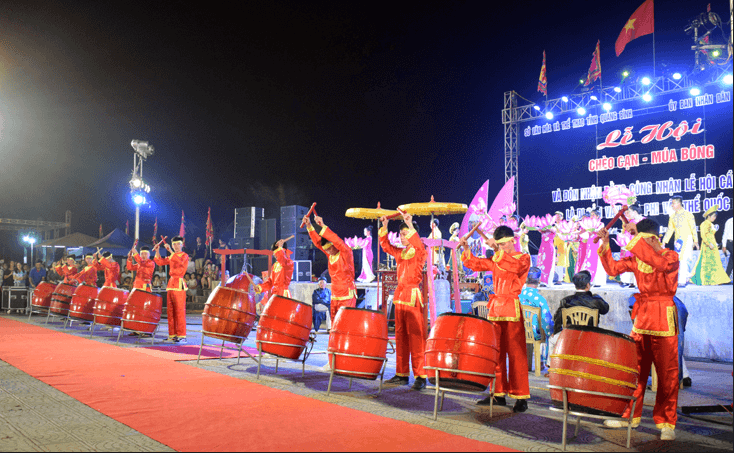
The “Cầu Mùa” (Seasonal Prayers) festival is held for three consecutive nights, from the 14th to the 16th of the fourth lunar month. In addition to the prayers for a bountiful fish season, the festival also includes the “múa bông – chèo cạn” (flower dance – river rowing) performance.
During the whale deity ceremony, two elderly people perform a spiritual medium session and speak sacred words. After the ceremony, the “múa bông – chèo cạn” performance takes place at the temple’s courtyard. The river rowing team consists of 24 unmarried girls, accompanied by two “hò” singers (one male and one female) performing traditional boat songs. The girls wear long dresses in yellow or purple, white pants, and their hair is styled in a bun with jasmine flowers pinned in. They hold 1.5-meter long wooden paddles and row in harmony to the rhythm of the song. A musical band with traditional instruments such as the sinh nhị (a two-stringed instrument), đàn nguyệt (moon-shaped lute), bamboo flute, gourd trumpet, and large drums provide accompaniment for the singing.
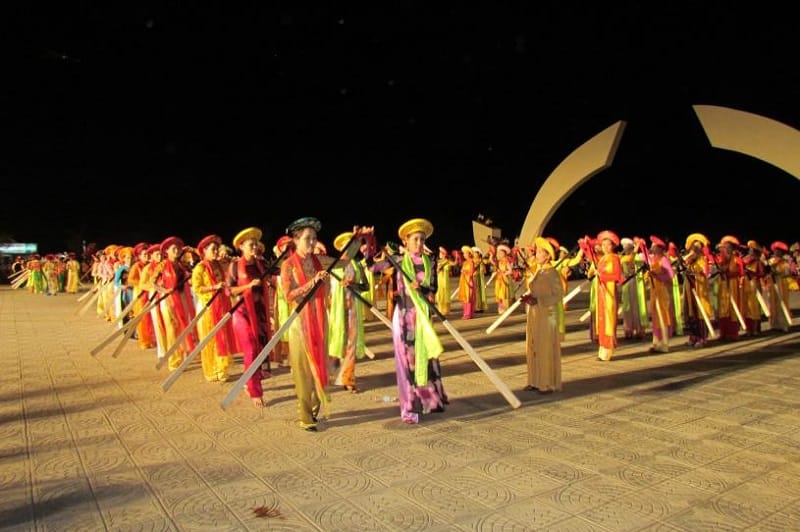
The boat song performance includes five types of singing: “hò mái dài” (long roof song), “hò mái ba” (three-peak song), “hò mái nện” (hammer song), “hò kéo lưới” (net-pulling song), and “hát khoan” (sung rhythm). Between the verses, the girls chant with phrases like “a xố đi xố…hà” or “ớ là…hố”. The lyrics typically ask for the blessings of heaven and the gods, praying for calm seas and abundant fish catches.
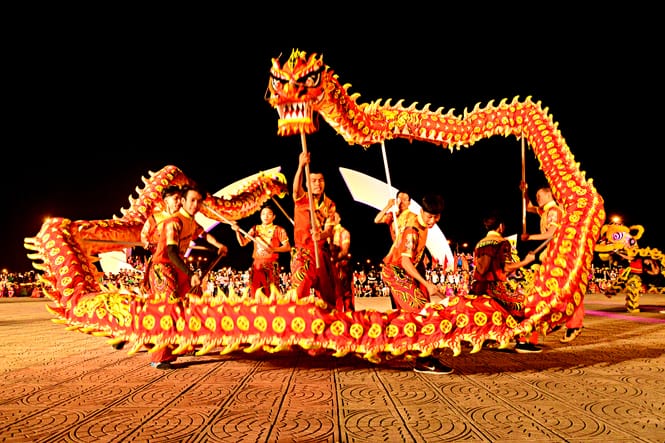
The flower dance team consists of 20 young, strong men, evenly matched in size, led by a conductor. The performers wear uniforms: white pants, a five-piece tunic in pink or red, and headbands with white crow-beak-shaped hats. They carry lanterns in the shape of square pots, lit with candles. The conductor wears martial arts attire, a red vest with a green belt, and a warrior’s hat adorned with a red fabric rose, holding a pair of hexagonal lanterns. The flower dance team enters the temple courtyard and performs various beautiful formations, resembling a brightly lit boat on the river or a dragon soaring and phoenix dancing. Meanwhile, the sound of drums and music creates a lively atmosphere.
The “Cầu Mùa” festival embodies the fishermen’s great wishes, honoring and offering prayers to the whale god, hoping for calm seas and a bountiful catch to ensure a prosperous and abundant life.